
.png)
Table of Content
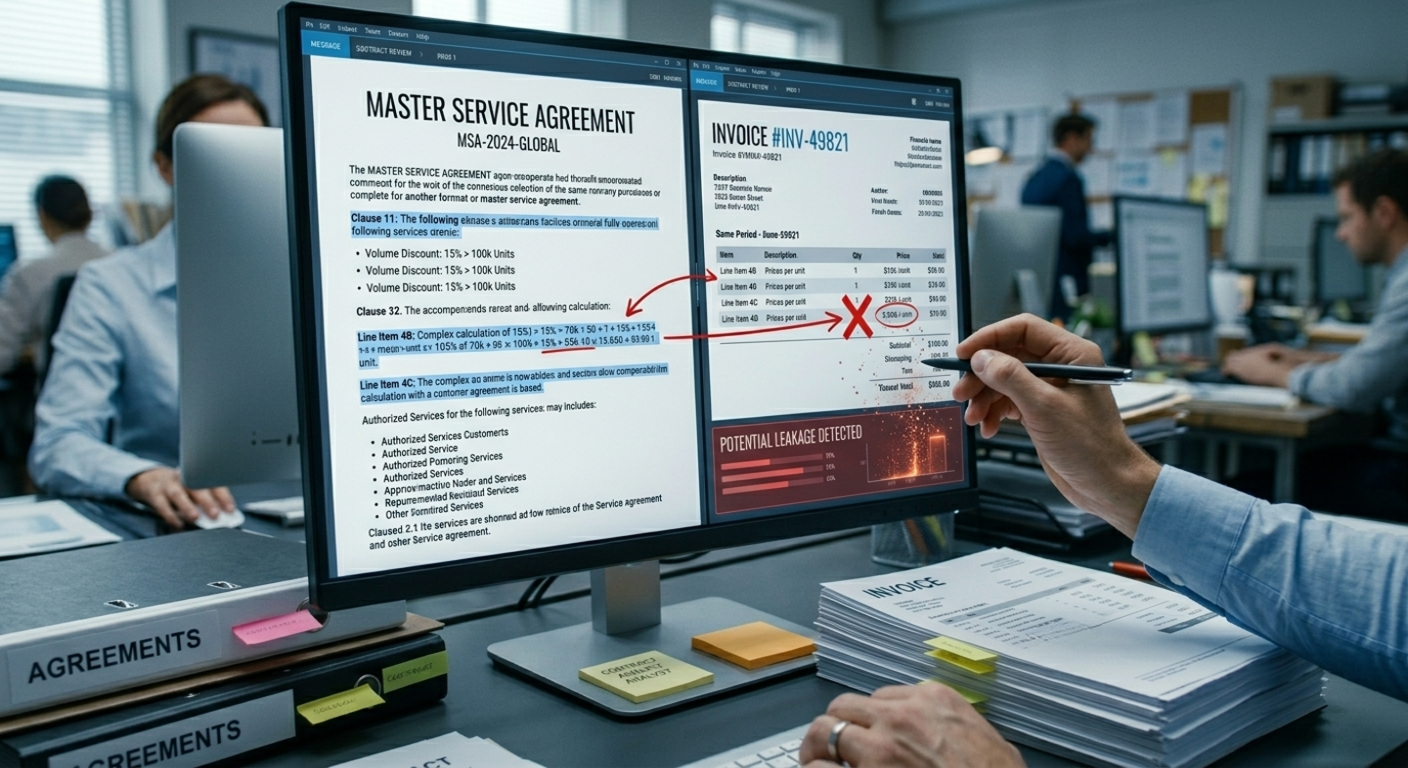
What us Revenue Leakage and Why Does is Metter?
Revenue leakage is one of the most common margin problems inside growing companies, and also one of the least visible.
Most companies do not lose revenue in one dramatic event. They lose it quietly. A pricing term is missed. An invoice goes out below contract rates. A surcharge never gets applied. A service credit is issued when it should not have been. A renewal clause gets ignored. A team keeps operating off an old agreement while finance assumes the contract is being enforced correctly.
That is revenue leakage.
At a practical level, revenue leakage is the gap between what a company should collect and what it actually collects because execution breaks down somewhere between the contract, the operation, and the invoice.
For CFOs and COOs, this matters for one simple reason: revenue leakage usually does not show up as a single line item. It hides inside operations. It sits across teams. It gets normalized. And by the time leadership notices it, the damage has often compounded for months.
Research from World Commerce & Contracting has repeatedly found that poor contract management costs businesses close to 9% of value annually, and other industry sources continue to cite that same range today.
Revenue leakage is the gap between what you should earn and what you actually collect
The statistic gets attention, but the real issue is not the number itself. The real issue is how ordinary the problem is.
In most organizations, revenue leakage is not caused by fraud or incompetence. It is caused by complexity.
A company grows. More customers come in. More vendors are added. More special terms are negotiated. More exceptions get approved. More contract versions circulate across email, shared drives, PDFs, and internal systems. Eventually, the commercial reality of the business becomes too complex for manual oversight alone.
At that point, even strong teams start missing things.
A contract analyst reviews a sample of invoices, but not all of them. An operations manager catches service issues, but not always the pricing implications. Finance bills based on what it received, not always on what the contract actually says. Legal negotiated the agreement, but legal is not reviewing thousands of downstream transactions every month.
Everybody is doing part of the job. No one is continuously enforcing the full picture.
That is where revenue leakage starts.
.png)
Why revenue leakage is so hard to detect
One of the biggest reasons revenue leakage persists is that it rarely looks urgent in the moment.
It usually appears as small mistakes spread across different workflows and teams. One missed charge does not look like a major issue. One incorrect invoice does not trigger an executive meeting. One unclaimed fee feels operational, not strategic.
But that is exactly how companies end up losing meaningful margin without realizing it.
Revenue leakage is hard to detect because it lives in the gaps between departments. Sales negotiates terms. Legal finalizes language. Operations executes delivery. Finance invoices the customer. Account teams handle escalations. When those groups are not aligned around the same source of truth, small inconsistencies accumulate.
And once that happens at scale, the issue becomes expensive.
A simple logistics example
Imagine a logistics company managing hundreds of customer contracts across lanes, service levels, surcharges, penalties, detention rules, and timing commitments.
One customer contract allows a fuel surcharge adjustment every quarter. Another includes detention charges after a certain number of hours. A third has a service credit clause tied to delivery performance. Several accounts operate on custom pricing that was negotiated outside the standard rate card.
Now multiply that across hundreds or thousands of invoices each month.
The company may have contract managers, analysts, finance staff, and account leaders all working in good faith. But if those people are checking manually, the odds of perfect enforcement are extremely low.
Maybe the detention charges were never added. Maybe an outdated pricing sheet was used. Maybe a customer was invoiced without a contractually required adjustment. Maybe credits were issued too broadly because the exact clause language was not reviewed in time.
None of those mistakes feels catastrophic on its own.
Together, they can drain millions from a business.
This is what makes revenue leakage dangerous. It is rarely one large failure. It is usually a long series of small execution misses that quietly reduce margin.
Why revenue leakage matters to CFOs and COOs
CFOs often see the symptoms before they see the cause.
Margins come in below expectation. Certain accounts look less profitable than expected. Forecasts miss. Write-offs increase. Billing disputes drag on. Teams start blaming pricing, operations, or finance, when the real issue is that the company has lost control over how commercial terms are enforced day to day.
COOs see a different version of the same problem.
Processes become harder to manage. Teams spend more time reconciling what happened after the fact. Leaders rely on heroic effort from employees who are constantly reviewing files, exceptions, and escalations. Execution slows down because people are working reactively instead of systematically.
Revenue leakage is not just a finance problem.
It is an operational discipline problem.
And the reason it matters is that it hits three things leadership cares about most: margin, predictability, and trust.
Margin suffers because the company is simply not collecting everything it has earned.
Predictability suffers because revenue becomes harder to forecast when execution is inconsistent.
Trust suffers because customers, operators, finance teams, and executives stop working from the same source of truth.
.png)
Where revenue leakage usually starts
The biggest misconception about revenue leakage is that it only happens in billing.
It does not.
Billing is where some of the damage appears. The problem usually starts earlier.
In many companies, leakage begins when contracts become difficult to interpret operationally. A term may be legally clear but operationally hard to track. An account team may know the spirit of a deal but not the exact enforcement rules. An invoice may be produced correctly according to a system, but incorrectly according to the actual agreement.
The issue is not always that people are careless. The issue is that most organizations were not built to continuously monitor contract execution at scale.
That is especially true in industries like logistics, procurement, and supply chain operations, where margin depends on thousands of recurring operational decisions.
Recent contract-management commentary continues to point to the same drivers: missed obligations, billing errors, pricing inconsistencies, manual renewals, and fragmented ownership after signature.
Why the problem gets worse as companies grow
Smaller companies can sometimes manage revenue leakage through strong people and close oversight.
As companies scale, that stops working.
Volume increases. Contract variety increases. Teams specialize. Data gets spread across more systems. Exceptions become normal. And the distance between the agreement and the invoice gets wider.
This is why leakage often gets worse as a company becomes more sophisticated, not less.
Growth adds complexity faster than most organizations add enforcement discipline.
McKinsey has also written about how value erodes when contract terms are not managed and enforced effectively after signature, especially in large sourcing and operational environments.
That matters because many executive teams still treat revenue leakage as a side issue. In practice, it is often one of the cleanest ways to improve financial performance without waiting for new sales.
You do not need to sell more to recover revenue you already earned.
You need better execution.
How companies are solving this in 2026
In 2026, more companies are turning to AI to solve revenue leakage.
Not generic AI. Not a chatbot layered on top of a workflow. And not a broad software platform that still leaves your team doing the hard part manually.
The companies making real progress are using AI that is customized around the actual way their business operates.
That matters because revenue leakage is rarely caused by one simple mistake. It comes from a mix of contract terms, invoice rules, pricing exceptions, service obligations, operational data, and human follow-through. Generic tools do not understand that context well enough to enforce it consistently.
To solve this well, AI has to be built around the company’s actual workflow. It needs to understand how contracts are structured, how invoices are generated, where exceptions happen, which clauses affect pricing, and how teams make decisions in practice. It also needs to produce outputs that are usable by operators, finance leaders, and executives, not just technical teams.
This is where companies like Sotant come in.
At Sotant, we build custom AI Employees designed to reduce revenue leakage and internal inefficiencies across real operational workflows. That includes areas like contract enforcement, logistics execution, procurement, and other margin-critical processes where errors compound quietly over time.
The point is not to add more software for the sake of innovation. The point is to give companies a practical way to monitor execution more closely, catch missed revenue faster, and reduce the amount of manual oversight required from internal teams.
Current contract-management analysis continues to position AI-enabled tooling as one of the most practical ways to detect missed obligations, reconciliation gaps, and billing inconsistencies earlier.
The key difference is that the AI has to be specific enough to your business to be useful. Otherwise, you are just adding another layer of tools without fixing the root problem.
Final thought
Revenue leakage matters because it is one of the few problems that can quietly reduce revenue, margin, and operational confidence at the same time.
It is rarely dramatic. It is usually buried in the day-to-day details of execution. That is exactly why many companies let it persist for far too long.
But once leadership starts looking closely at the gap between what was agreed, what was executed, and what was billed, the issue becomes impossible to ignore.
The companies that address this well do not treat revenue leakage as administrative cleanup. They treat it as an operational priority tied directly to margin protection.
Because that is what it is.
If you want to learn how Sotant can fix revenue leakage for your company, book a demo today.
Fix revenue leakage before it compounds
See how Sotant AI Employees help companies reduce revenue leakage, improve execution, and protect margins without adding headcount.
.png)
.png)