.png)
Table of Content
Growth creates pressure to add headcount fast. Learn how enterprises are using AI Employees to increase output, protect margins, and scale with less hiring.
.png)
How Growing Enterprises Can Scale Without Expanding Headcount
Growth is usually treated as a purely positive story.
More revenue, more customers, and more expansion.
But inside an enterprise, growth creates a second story at the same time. As the business expands, leaders are suddenly asked to solve two difficult problems together: how to sustain the growth, and how to build enough internal capacity to support it.
That combination is where scaling becomes hard.
New customers bring more contracts, exceptions, approvals, compliance requirements, procurement work, invoicing logic, and operational follow-through. In many companies, the default response is predictable: expand teams across analysts, managers, vendors, and support functions to keep up with the complexity.
Sometimes that is necessary. But it is not always the best answer.
More headcount can relieve pressure in the short term while also creating new layers of cost, coordination, training, recruiting, and turnover. Deloitte’s 2026 finance trends coverage highlights that many finance leaders are already rethinking operating models as AI expands what teams can do, especially when applied to focused, high-value workflows.
The question for enterprise leaders is becoming more practical:
How much of the new workload truly requires adding more people, and how much of it can be absorbed differently?
Why growth creates two problems at once
When a company grows, the first problem is obvious: leadership has to keep the business moving.
The second problem is more operational: the company now needs more work done internally to support that growth. More reviews, approvals, checks, reporting, compliance monitoring, contract enforcement, invoice validation, and follow-up.
This is where many enterprises get stuck.
The commercial side of growth looks successful, but the operating side becomes heavier and more expensive. Margins start absorbing the cost of expansion. Teams get stretched. Managers become bottlenecks. Recruiting becomes constant. And even after hiring, companies still face training time, turnover, agency fees, and coordination costs.
That is why growth is not always as straightforward as it seems. It can create real operational drag if the business relies too heavily on scaling people linearly with workload.
.png)
Why adding headcount is not always the best answer
The traditional enterprise model is simple: as workload increases, teams expand.
That logic made sense for a long time. If more contracts need to be reviewed, hire more analysts. If more procurement processes need support, hire more specialists. If compliance work increases, expand the team. If invoice checks become harder, add more finance staff or external vendors.
The problem is that this model becomes expensive quickly.
Hiring is slow. Good people are hard to find. Turnover resets productivity. Outside agencies charge significant fees. Internal teams require onboarding and management. And once a company builds fixed headcount around a temporary spike in complexity, those costs do not disappear easily.
This does not mean enterprises should stop hiring. It means they should become more selective about which work truly needs a new person and which work requires a better operating model.
That is where AI Employees are starting to change the conversation.
What AI Employees actually are
AI Employees are not just software, chatbots, or tools.
They are a new way of deploying technology around work.
The easiest way to understand an AI Employee is to think of it as a specialized digital operator designed around a real workflow. Instead of asking your team to learn another tool and manually drive every step, the AI Employee is configured to perform recurring operational work more like an internal analyst or contractor.
That work can include:
- Reviewing documents
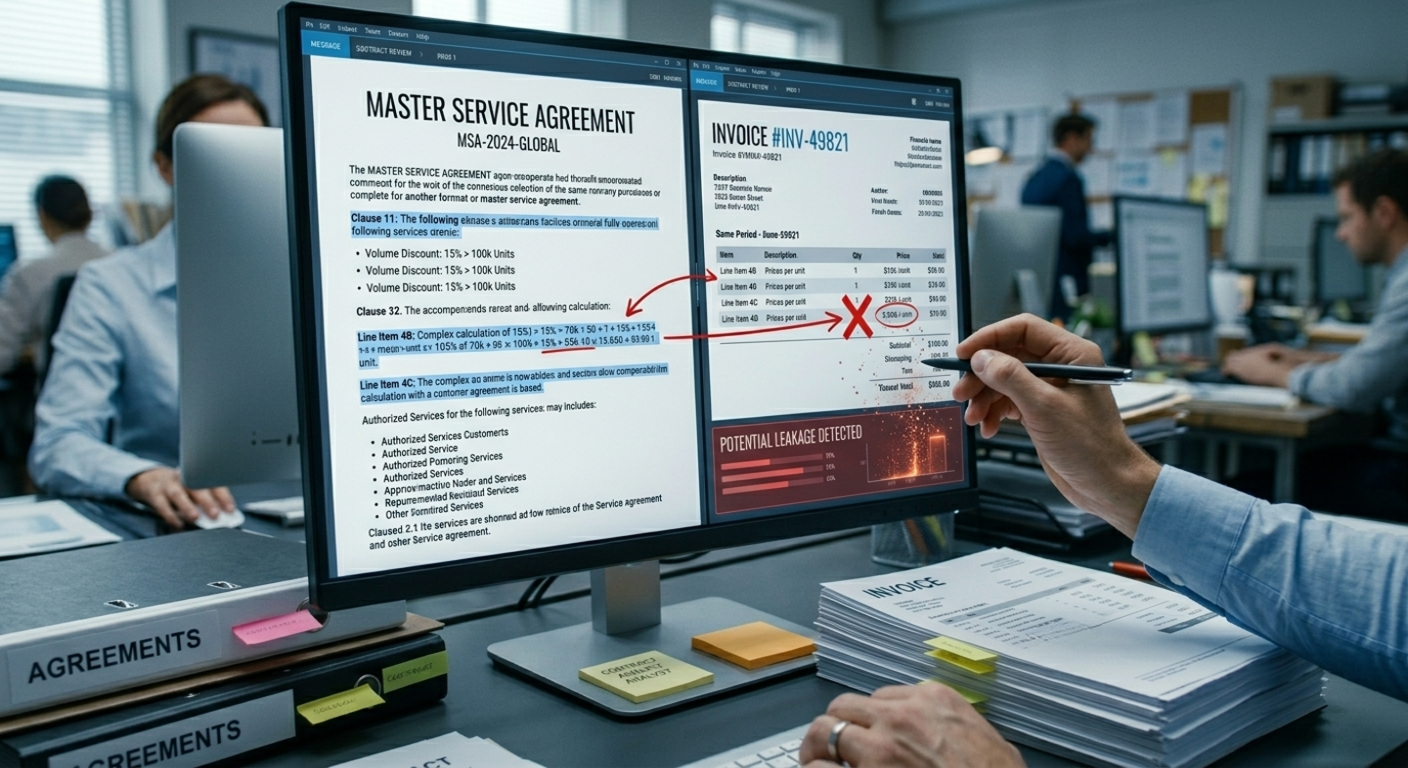
- Comparing contracts and invoices
- Monitoring obligations
- Surfacing discrepancies
- Checking compliance conditions
- Flagging missed charges
- Escalating findings to decision makers
The important distinction is that the enterprise does not need to treat this like a traditional IT build.
In many cases, the AI Employee can be onboarded more like a new vendor, analyst, or contractor. The workflow is defined, access is provided, and the AI Employee is configured around the work that needs to be done. This is very different from a heavy internal software implementation.
.png)
What kind of work AI Employees do
The most useful AI Employees are built around specific operational work, such as:
- Contract management support
- Compliance monitoring
- Procurement tracking
- Contract enforcement
- Revenue leakage control
This is the kind of work that often consumes a large amount of human effort without requiring deep creativity every time. It is structured enough to be systematized, but important enough that the business cannot afford to ignore it.
A practical example of how this changes operations
Imagine a growing enterprise with a large portfolio of customer agreements and vendor relationships.
As the business expands, so does the number of contract amendments, pricing exceptions, supplier terms, approval paths, and invoice checks that need to happen. Leadership now has two options.
Option one is familiar: continue hiring people to manage the complexity.
Option two is different: introduce AI Employees designed around the specific operational work that is increasing.
Instead of hiring multiple roles to manually compare contracts against invoices and flag discrepancies, an enterprise can deploy an AI Employee to handle a large share of that recurring work and route exceptions to the current team.
This does not replace the human team. It allows the existing workforce to operate at a much higher level of output.
Why this model is different from traditional software
Traditional enterprise software usually asks the company to adapt its processes around the tool.
AI Employees flip that model.
Instead of buying another system and asking teams to manually operate it, the enterprise defines the work, and the AI Employee is configured around that workflow.
That matters for one reason above all: speed to value.
Many enterprises do not need another long implementation cycle. They need support now, especially in areas where hiring is slow and workload is growing.
How Sotant helps enterprises implement AI Employees
Some companies are already implementing this approach in practice.
At Sotant, we build custom AI Employees for enterprises that need to grow without expanding headcount in a linear way.
We focus on operational workflows where complexity creates cost: contract management, compliance, procurement, contract enforcement, invoice review, and other areas where inefficiencies build over time.
Our approach is practical. We identify one workflow, audit how it operates, and build a custom AI Employee around it.
The goal is simple: give your current team more leverage.
Final thought
For a long time, scaling meant hiring.
And in many cases, it still does.
But enterprises now have another option.
AI Employees give companies a way to add operating capacity without expanding headcount at the same pace as workload. They help teams handle more output, reduce repetitive work, and support growth without creating the same overhead that comes with large hiring waves.
This shift is not just about automation. It is about changing how enterprises think about scale.
If you want to explore how this works in practice, you can learn more about how Sotant applies this approach.
.png)